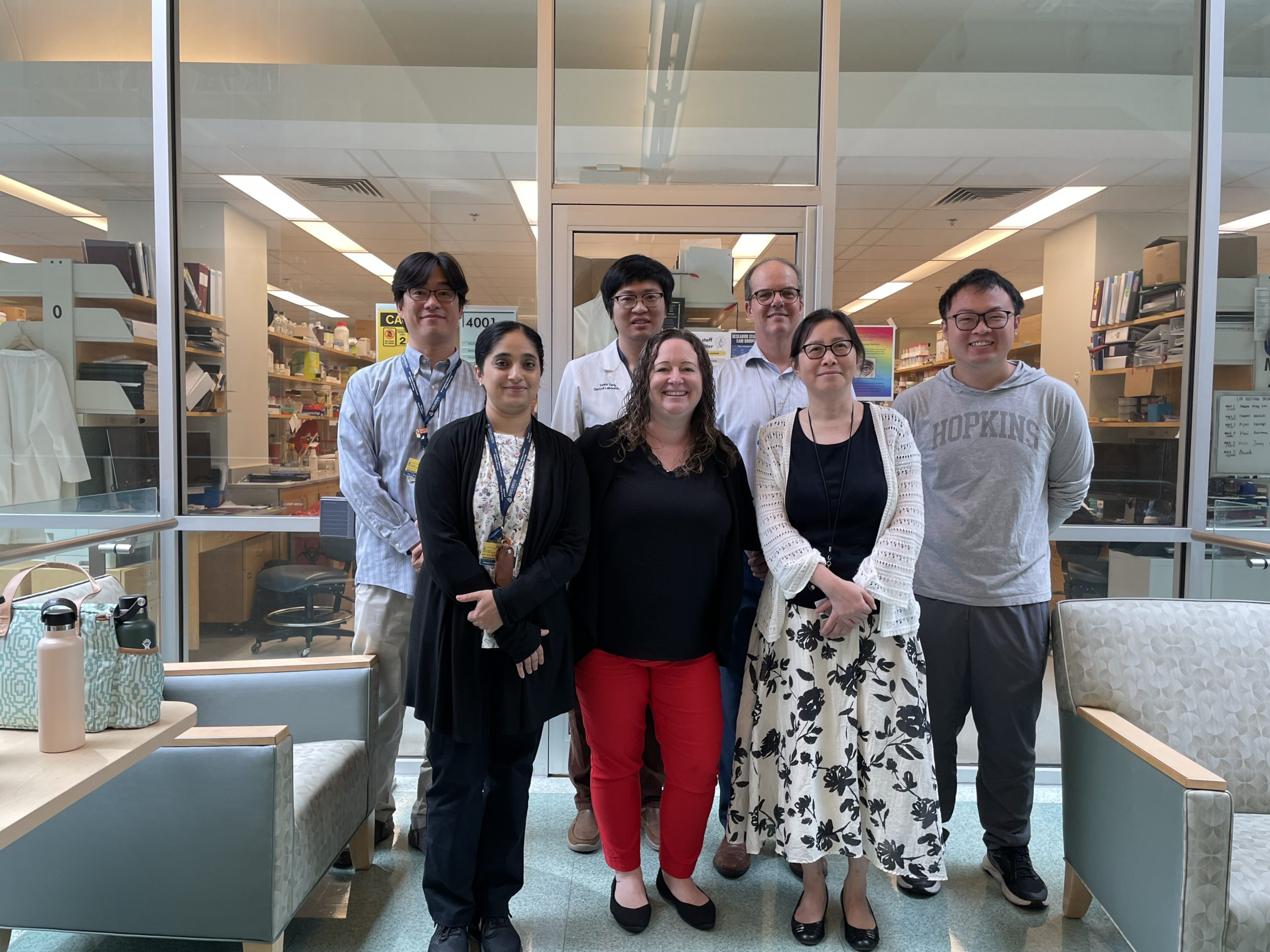
CCF-funded pediatric oncologist Robyn Gartrell, M.D. invited CCF to visit her lab at the Eye and Brain Tumor Lab at Johns Hopkins Hospital, where she currently serves as Assistant Professor of Oncology within the Division of Pediatric Oncology at the Johns Hopkins Kimmel Cancer Center.
CCF funded Dr. Gartrell’s research in Diffuse Midline Glioma (DMG) throughout 2025. DMG, which includes Diffuse Intrinsic Pontine Glioma (DIPG), accounts for about 10-20% of all pediatric brain cancers, are extremely aggressive and have limited response to treatment. DIPG is well-known to the cancer community as having the poorest prognosis, with less than 1% surviving 5 years after diagnosis. CCF is proud to support the important work of Dr. Gartrell and her team.
Dr. Gartrell shared with CCF that her “Aha!” moment arrived when a child’s lung tumors responded remarkably to radiation, after which she was able to see under a microscope that this response was due to immune cells attacking the tumor. This work was thought to be a clue that combining immunotherapy with radiation is the key given immunotherapy has not been as successful in solid tumors like brain cancer and other central nervous system cancers.
While immunotherapy can play an important role in advancing outcomes and cures, Dr. Gartrell and her colleagues recognize that there must be additional treatments that target the tumor while protecting healthy cells. Strategies like proton treatment radiation are good examples, as are targeted chemotherapies that can carry out a very specific purpose. Dr. Gartrell’s research is currently exploring how proton beam therapy could be more successful if the cancer was exposed to a FLASH treatment that is delivered much faster than standard radiation therapy. Findings so far have shown incredible retention of brain cognition in young mice, while still killing tumors.
Dr. Gartrell’s work is being used to develop a concept for clinical trial in human patients, starting with DMG. She shared these findings with the larger local research community at CCF’s 10th Annual CCF Research Symposium in June 2026. Dr. Gartrell leads by example and is the model researcher, advocating on behalf of the pediatric cancer community, noting that funding must remain strong and steady.
While much of Dr. Gartrell’s research is something I do not understand on the molecular level (literally), what I do understand is the big picture: pediatric cancer research must be prioritized. It must be funded and must remain top of mind. And, one researcher at a time, we are doing that. With researchers like Dr. Gartrell leading the charge, we will find our way to survival. CCF is lucky to have Dr. Gartrell on the team.
We often talk about how important it is that CCF is local. But it goes beyond just raising funds for researchers and programs; CCF prides itself on building a powerful community dedicated to curing childhood cancer. The relationships between CCF, researchers, families, and the business community provide a cycle of support, advocacy and scientific advancement.
Everyone has a role to play in advocating to ensure pediatric cancer remains funded. It is the only path leading to better treatments, cures and survival.
Dr. Gartrell joined me for a podcast earlier this year, hosted by Marianne Banister, founder of the Claire Marie Foundation. Marianne is another exemplary role model. Marianne shared her personal journey of losing her daughter, Claire, in a 2024 CCF video. Marianne’s podcast featuring Dr. Gartrell emphasized the importance of securing additional pediatric cancer funding. View the full video of the podcast or search “An Unexpected Life” in your podcast app.
As president of CCF, I am fortunate to meet incredible leaders in the local pediatric cancer community. These partnerships not only unite us, but bring the promise of cures.